


What boats can I operate with the basic boating license? Power, length, and updated limits
If you're thinking about getting your boating license or have just obtained it, it's normal that one of the first questions that comes to mind is exactly this: What boats can I sail now? The Boating License opens the door to the world of the sea, but like any qualification, it has its limits in terms of power, length, and navigation area that you should be familiar with before heading out on the water.
This article explains clearly and in an up-to-date way which boats you can operate with the basic boating license, what its real limitations are, and when you'll need to upgrade to a higher qualification. Because knowing exactly what you can and can't do is the first step to enjoying the sea with complete peace of mind.

What is a Navigation License or Titulín?
The "titulín," officially known as the Navigation License, is the most basic nautical qualification in Spain and the perfect entry point for those who want to start sailing without undergoing lengthy or expensive training. It's the minimum authorization that allows you to operate recreational boats independently in Spanish waters, always within certain limits of power, length, and distance from the coast, which you should be familiar with before heading out to sea. If you don't yet have this license, an alternative for enjoying the sea is to book a... boat trip in Malaga with a skipper, since you won't need any qualifications to sail.
The training to obtain the basic boating license is very accessible: it doesn't require an official theory exam, as it's sufficient to complete a practical course approved by the Directorate General of the Merchant Marine. These courses are taught by authorized nautical schools and usually last between 4 and 8 hours, depending on the school and the student's starting level. Once the practical course is completed, the school directly processes the license, which is valid for 10 years, after which it must be renewed.
The cost of the course varies depending on the school and the autonomous community, but it typically ranges between €100 and €200, making it the cheapest and fastest way to obtain a nautical qualification in Spain. There is no legally mandated minimum age to take the course, although most schools recommend being at least 16 years old.
Difference between Titulín and Navigation License
Although the terms are used interchangeably in everyday language, it's important to clarify that the "titulín" and the "License de Navegación" (Navigation License) refer to the same qualification. The term "titulín" is simply the popular name in Spain for the Navigation License, possibly because it's the lowest-ranking nautical qualification within the official Spanish system.
Where there is a significant difference is between the "titulín" (basic boating license) and the other nautical qualifications. Above the Navigation License, in ascending order, are the Basic Navigation Skipper (PNB), the Recreational Craft Skipper (PER), and the Yacht Skipper (PY), each with greater privileges in terms of length, engine power, and permitted distance from the coast. The main difference between the "titulín" and these is that it does not require an official theory exam, making it much more accessible but also more limited in terms of the types of vessels it allows you to operate.
Types of Boats You Can Operate with the Basic Boating License
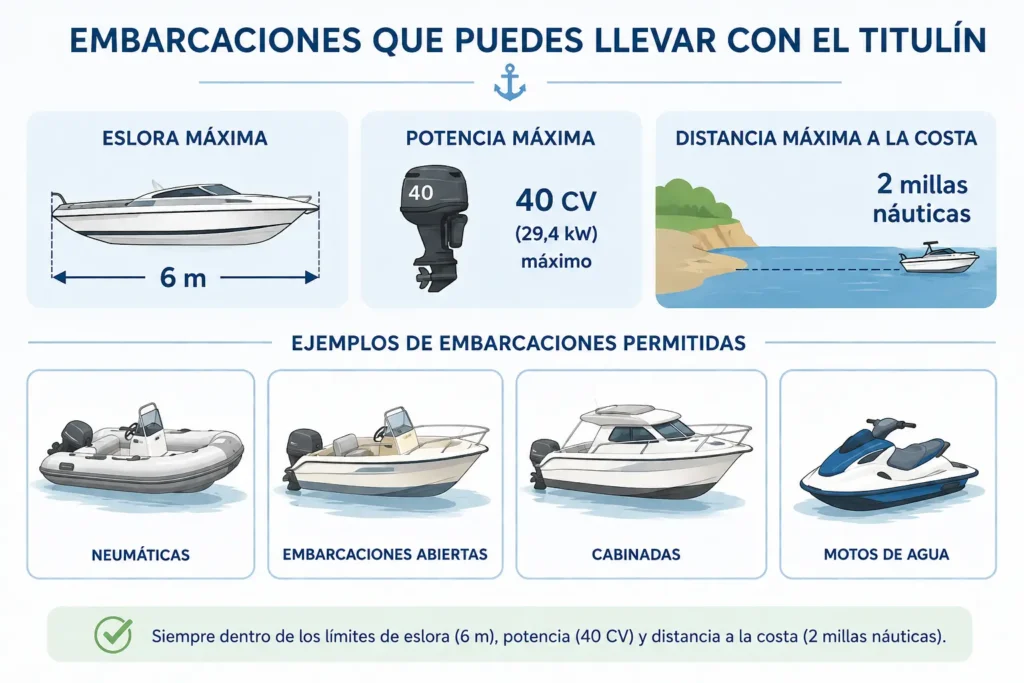
With a Navigation License, you can operate vessels that simultaneously comply with the power and length limits established by Spanish regulations. It is important to understand that both limits must be met: it is not enough to respect one if the other is exceeded.
The general limits are:
- Maximum length: 6 meters
- Maximum power: 40 HP (horsepower) or its equivalent in kW
- Maximum distance to the coast: 2 nautical miles
1. Inflatable and Semi-Rigid Boats
Inflatable boats and semi-rigid boats (also known as RIBs) are probably the most common among those using the basic boating license. As long as they don't exceed 6 meters in length or 40 HP, they can be operated with this license without any problems. They are very popular for leisure activities, sport fishing, and accessing coves that are difficult to reach from land. Their maneuverability and ease of handling make them especially recommended for those who are starting out on the water. If you don't yet have this license, you can also enjoy a similar experience by hiring a boating guide. Boat trip in Malaga with skipper, without needing to obtain a license.
Limitation to consider: Many semi-rigid boats on the market exceed 40 hp, especially those designed for sport. Always check the boat's technical specifications before assuming you can operate it with a basic boating license.
2. Motorboats
Motorboats are another common type of vessel among those who hold a basic boating license, always within the limits of 6 meters in length and 40 hp. The market offers a wide range of boats specifically designed to meet these requirements, making it easy to find a suitable vessel for use with this license. They are ideal for coastal excursions, water sports, and fishing.
Limitation to consider: The 2-nautical-mile limit from the coast significantly restricts your range. For navigation in more open waters or longer voyages, you'll need a higher qualification.
3. Jet Skis
Personal watercraft, also known as jet skis, can be operated with a basic boating license (titulín) as long as the power does not exceed 40 hp. However, most jet skis on the market today far exceed this limit, so in practice it is difficult to find a commercially available jet ski that can be legally operated with just a basic license. Research thoroughly before renting or buying a jet ski if you only have a basic boating license.
Limitation to consider: In addition to power, jet skis have their own regulations for use in seaside areas and distances from the coast that vary according to the autonomous community.
4. Sailboats
As for sailboats, the basic boating license (titulin) allows you to operate sailboats as long as they do not exceed 6 meters in length. In this case, the power limitation applies to the auxiliary engine, if it has one. It's a less common option among titulin holders, but perfectly valid for those who want to start sailing on small boats.
Limitation to consider: A 6-meter sailboat has a fairly limited range for offshore navigation, so this combination is more suitable for coastal navigation and port areas.
5. Kayaks and Rowing Boats
Rowing craft, such as kayaks and canoes, do not technically require any type of nautical license in Spain, but the rules change if an auxiliary motor exceeding a certain power is added. For kayaks and purely rowing craft without a motor, no license is required for use in Spanish waters.
Limitation to consider: If you add an electric or gasoline motor to a kayak or canoe, consult the specific regulations, as it may require registration and certification.
6. Types of Boats I Can Operate Without a Basic Boating License
In Spain there are some boats that can be used without any type of nautical qualification, although always within very specific limits:
Rowing craft (kayaks, canoes, rowboats) do not require any license for use in Spanish waters, provided they are not motorized. Surfboards, paddleboards, and similar watercraft also do not require a license, although they must comply with the regulations for use in beach areas.
Motorboats with a power output not exceeding 4.4 hp and a length of up to 2.5 meters can be used without a license in some cases, although the regulations may vary depending on the autonomous community and the navigation area.
It is important to note that sailing without a license on vessels that require one can result in significant financial penalties, as well as posing a risk to one's own safety and that of others at sea.
In what locations is the Titulín useful?
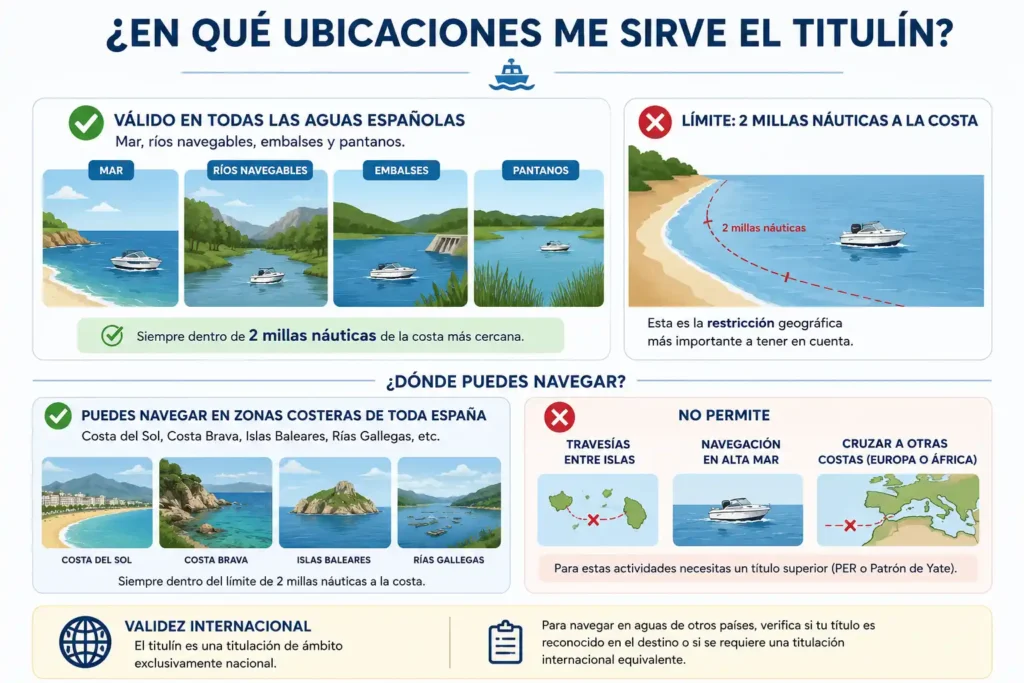
The basic boating license (or navigation license) is valid in all Spanish waters, both at sea and inland waters such as marshes, navigable rivers, and reservoirs. However, the 2-nautical-mile limit from the coast is the most important geographical restriction to bear in mind.
In practical terms, this means that with the basic boating license (titulín) you can navigate freely along coastal areas throughout Spain: from the Costa del Sol to the Costa Brava, including the Balearic Islands and the Galician Rías, always staying within 2 nautical miles of the nearest coast. If you don't yet have this license and want to enjoy the sea without worrying about navigation restrictions, a boat trip in Malaga With a guide, it's an excellent option to experience it safely and without needing a license.
The basic boating license does not allow you to travel between islands, navigate on the high seas, or cross to other European or African coasts. For that, you will need a higher qualification such as the Recreational Skipper's Certificate (PER) or the Yacht Master's Certificate.
Regarding international validity, the "titulin" is a qualification valid exclusively within Spain. If you wish to sail in the waters of other countries, you will need to verify whether this qualification is recognized in your destination or if an equivalent international qualification is required.
What Other Licenses Might I Need?
If the basic boating license falls short of your navigation needs, the Spanish nautical qualification system offers several options depending on the type of vessel and the area where you want to navigate:
1. Basic Navigation Pattern (PNB)
The PNB is the next step up from the basic boating license. It allows you to operate boats up to 8 meters in length and navigate up to 5 nautical miles from the coast. It requires passing an official theory exam in addition to the practical component, and is the recommended qualification for those who want more freedom to navigate without the complexity of the PER (Recreational Skipper's License).
2. Recreational Craft Skipper (PER)
The PER (Recreational Skipper's License) is probably the most popular nautical qualification in Spain. It allows you to operate boats up to 15 meters in length and sail up to 12 nautical miles from the coast, opening up a much wider range of possibilities than the basic boating license. It is the recommended qualification for those who want to rent larger boats or take longer trips along the Costa del Sol and other areas of the Mediterranean.
3. Yacht Master (PY)
The Yacht Skipper's Certificate allows you to sail recreational vessels of any length and extends your sailing area up to 60 nautical miles from the coast. It's the right qualification for those who want to undertake long voyages, travel to other European coasts, or sail on large vessels. Its training is significantly more extensive than that of the Recreational Skipper's Certificate (PER).
4. Yacht Captain (CY)
The highest level nautical qualification for recreational boating in Spain. The Yacht Captain's license allows unlimited distance from the coast on vessels up to 24 meters in length. It is the title chosen by those who want to undertake great ocean voyages or circumnavigations without geographical restrictions.
FAQ
From what age can you obtain the teaching certificate?
You can obtain a Navigation License from the age of 16, without the need for an adult to sign the application.
Can I rent a boat with a basic boating license?
Yes, provided the rental vessel complies with the length and power limits allowed by the boating license. Always check with the rental company what qualifications are required for each vessel.
Does the boating license allow me to navigate at night?
The Navigation License does not include specific authorization for night navigation. To navigate at night, it is recommended to have the Basic Navigation Certificate (PNB) or higher, which does include night navigation training.
How much does it cost to obtain the degree certificate?
The cost varies depending on the nautical school and the autonomous community, but generally ranges between €100 and €300 including the preparatory course and the official exam fees.
Can I sail outside of Spain with the basic boating license?
No, the Navigation License is only valid in Spanish waters. To navigate abroad, you will need an internationally recognized qualification such as the PER or the Yacht Skipper.
Can I carry passengers with the basic driving license?
Yes, you can take passengers on board as long as the vessel complies with safety regulations and the number of people does not exceed the maximum capacity indicated by the manufacturer.