
Ship, Vessel, Yacht or Boat: What's the Difference and When to Use Each Term?
How many times have you used the words boat, vessel, yacht, or craft without being entirely sure if you were using them correctly? Don't worry: it's one of the most common mistakes, even among people who spend a lot of time near the sea. In everyday language, we tend to use them interchangeably, but in the nautical world, each term has a precise meaning that's worth knowing.
Knowing how to distinguish between them isn't just a matter of vocabulary: it will also help you better understand nautical regulations, communicate effectively with industry professionals, and ultimately, navigate the maritime world with greater ease. In this article, we explain the real differences between these four terms, with a comparison table for your convenience.

The Ship
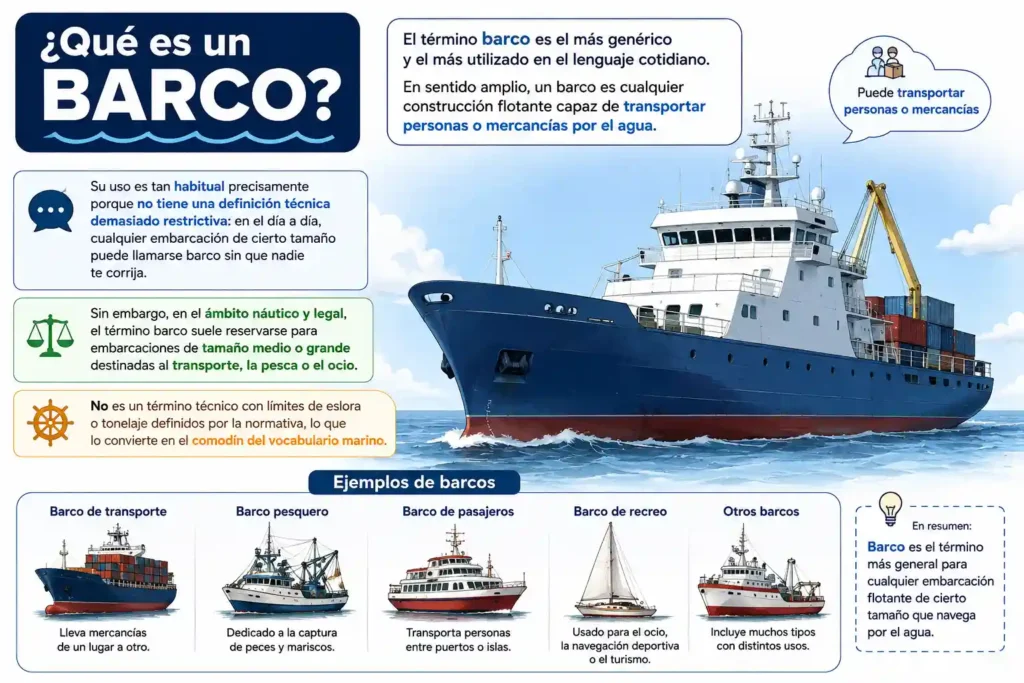
The term ship It's the most generic and the most used in everyday language. Broadly speaking, a ship is any floating structure capable of transporting people or goods across water. Its use is so common precisely because it doesn't have a very restrictive technical definition: in everyday speech, any vessel of a certain size can be called a ship without anyone correcting you. In fact, when you book a boat trip in Malaga, It is common to use this term generically, regardless of the type of vessel you are going to sail in.
However, in nautical and legal contexts, the term "ship" is generally reserved for medium-sized or large vessels used for transport, fishing, or leisure. It is not a technical term with legally defined length or tonnage limits, making it a versatile term in maritime vocabulary.
When to use it? In everyday conversation, it's used to refer to any boat of a certain size without needing to specify. It's the safest term when you don't know exactly what kind of boat you're looking at.
Vessel
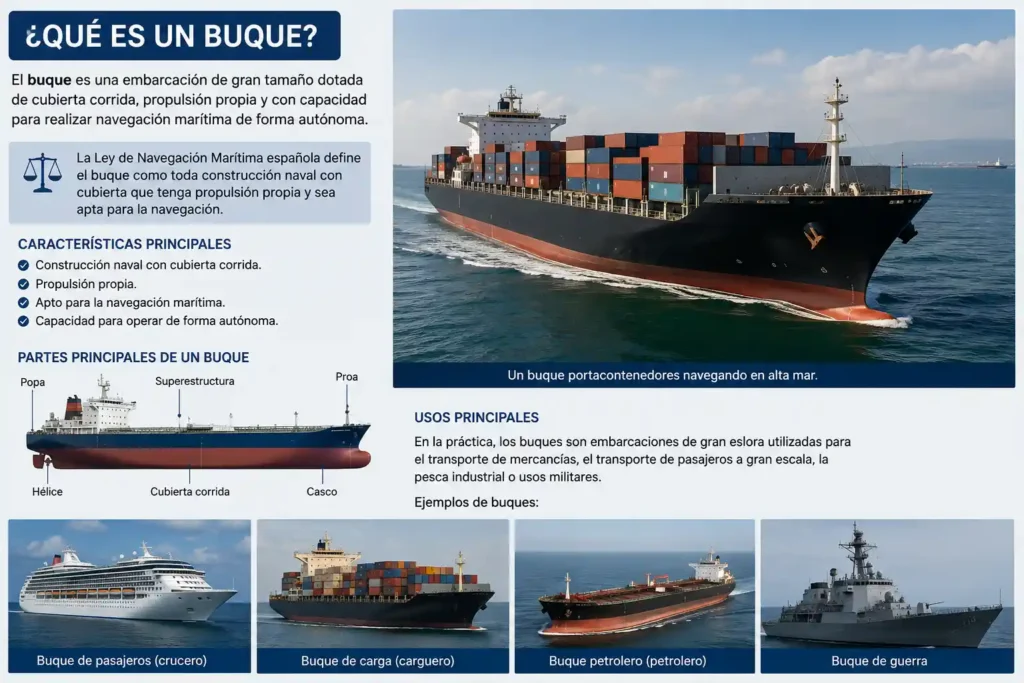
He vessel It is the most technical and precise of the four terms. According to Spanish regulations and international maritime law, a ship is a large vessel with a continuous deck, its own propulsion, and the capacity to navigate autonomously. The Spanish Maritime Navigation Law defines a ship as any naval construction with a deck that has its own propulsion and is suitable for navigation.
In practice, ships are large vessels used for transporting goods, large-scale passenger transport, industrial fishing, or military purposes. A cruise ship, a cargo ship, an oil tanker, or a warship are clear examples of what is understood by the term "ship" in the strict sense.
When to use it? When referring to large, self-propelled vessels intended for professional or commercial maritime navigation, this is the correct term in legal, technical, or professional contexts.
Vessel
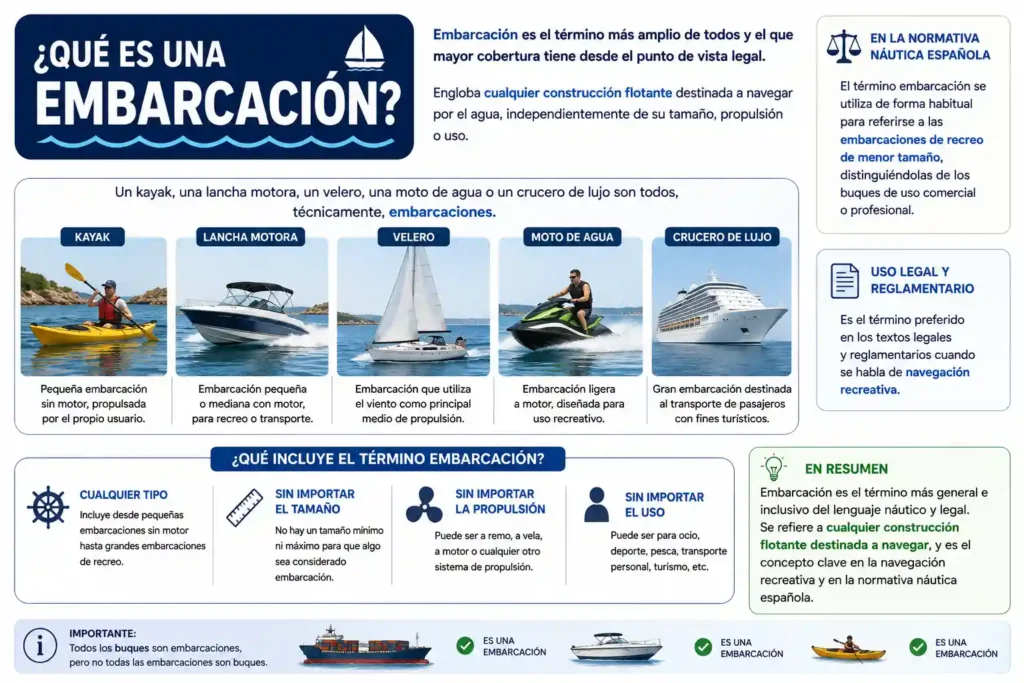
Vessel It is the broadest term of all and the one with the greatest legal coverage. It encompasses any floating structure intended to navigate the water, regardless of its size, propulsion, or use. A kayak, a motorboat, a sailboat, a jet ski, or a luxury cruise ship are all, technically, vessels.
In Spanish nautical regulations, the term "vessel" is commonly used to refer to smaller recreational craft, distinguishing them from vessels used for commercial or professional purposes. It is the preferred term in legal and regulatory texts when discussing recreational boating.
When to use it? When you want to be precise and encompass any type of watercraft regardless of size or use, it is the most accurate term in technical or legal contexts related to recreational boating.
Yacht
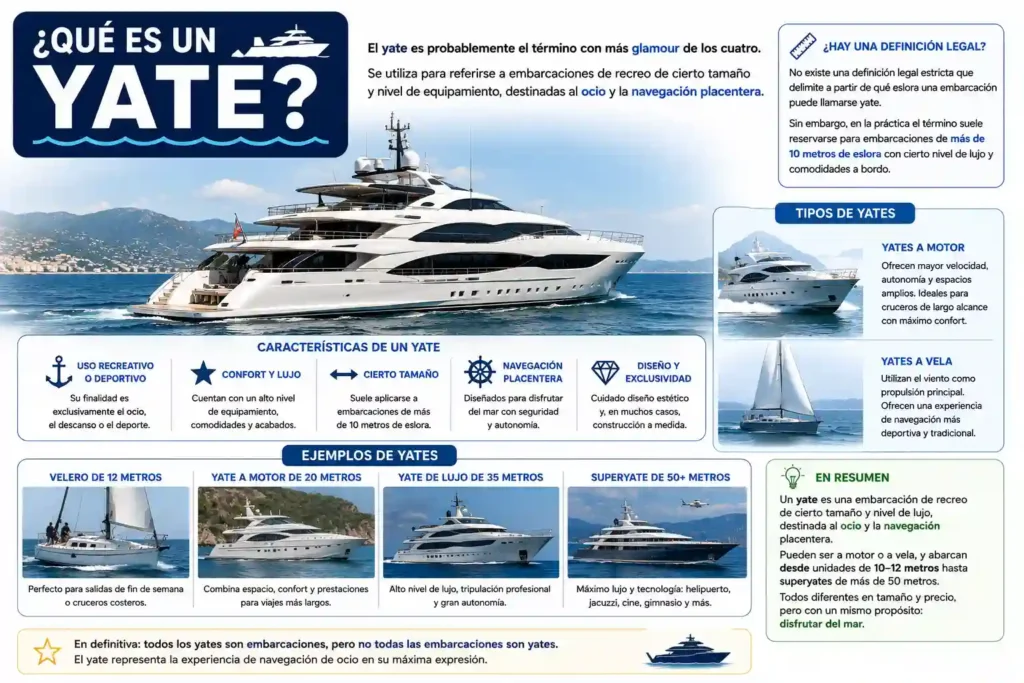
He yacht It is probably the most glamorous of the four terms. It is used to refer to recreational vessels of a certain size and level of equipment, intended for leisure and pleasant cruising. There is no strict legal definition that delimits from what length a vessel can be called a yacht, although in practice the term is usually reserved for vessels over 10 meters in length with a certain level of luxury and amenities on board.
Yachts can be motorboats or sailboats, and their use is exclusively recreational or sporting. From a 12-meter sailboat to a 50-meter superyacht with a helipad and jacuzzi, all can be called yachts, although they obviously have nothing in common in terms of size and price.
When to use it? When referring to recreational boats of a certain size and level of equipment, it is the appropriate term to talk about leisure boating on mid-to-high-range vessels.
| Ship | Vessel | Vessel | Yacht | |
| Use | Generic | Technician/professional | Technical/broad | Recreational |
| Size | Medium-large | Big | Any | Medium-large |
| Propulsion | Any | Own | Any | Motor or sail |
| Purpose | Transport/Leisure | Commercial/Military | Any | Leisure/recreation |
| Deck | Generally, yes. | Mandatory | Not necessary | Generally, yes. |
| Context | Colloquial | Legal/Technical | Legal/Technical | Colloquial/nautical |
| Example | Ferry, sailboat | Cruise ship, cargo ship | Kayak, boat | Luxury sailboat |
What Qualification Do I Need Depending on the Type of Vessel?
One of the most practical aspects of distinguishing between these terms is understanding which nautical qualification is needed to operate each type of vessel. In Spain, regulations establish different requirements depending on the size and use of the vessel:
For recreational boats small in size, the Navigation License or certificate It is sufficient if they do not exceed 5 meters in length and 15 HP of power. Basic Navigation Pattern (BNP) extends those limits to 8 meters, while the Recreational Craft Skipper (PER) It allows you to operate boats up to 15 meters long. If you're looking to enjoy the sea without needing a license, hiring a skipper is an excellent alternative. boat trip in Malaga with a skipper, an increasingly popular option for discovering the coast from the sea.
For the yachts larger in size, the Yacht Master or the Yacht Captain These are the appropriate qualifications, depending on the length and distance from the coast where you want to sail.
The ships Commercial or professional use requires Merchant Marine qualifications, a training and certification system completely different from that of recreational boating and regulated by the Ministry of Transport.
Interesting Facts About Nautical Language You May Not Know
The nautical vocabulary is full of terms that we unknowingly use incorrectly in everyday language. Here are some interesting examples worth knowing:
The bow It is the front part of the ship and the stern the rear, but did you know that the right side is called starboard and the left portThese terms originated in sailing and remain mandatory in professional maritime communication. If you decide to enjoy a boat trip in Malaga, It is very likely that the skipper will use some of this terminology during navigation.
When we talk about the length When we refer to a vessel's length, we mean its total length from bow to stern, while the sleeve is its maximum width and the draft the depth it occupies underwater.
And a curious fact that surprises many: technically, There is no ship called Titanic. The famous ocean liner was officially a vessel, Since it had its own propulsion, a continuous deck, and was intended for the commercial transport of passengers, the popular use of the term "ship" to refer to it is one of the most famous examples of colloquial versus technical usage.
FAQ
Is a boat the same as a ship?
Not exactly. Although they are often used interchangeably in everyday language, "vessel" is a technical term referring to large, self-propelled vessels with a continuous deck, designed for professional maritime navigation. "Ship" is a more generic and colloquial term.
Is a yacht a boat?
Yes, broadly speaking, a yacht is a type of boat or vessel intended for leisure and recreational boating. The difference lies in its use and size, not in a different legal category.
What is the smallest boat that exists?
Technically, any floating structure that allows navigation is a vessel, so even a motorized surfboard or a kayak falls into this category. There is no legally defined minimum size.
Is a cruise ship a vessel or a boat?
A cruise ship is technically a vessel, since it meets all the requirements of the legal definition: large size, continuous deck, self-propulsion and commercial use for passenger transport.
Do I need a license to operate any type of vessel?
No. Rowing boats, paddleboards, and motorboats under 6 HP do not require a boating license in Spain. For all other types of boats, the required license depends on the size and power of the vessel.


