


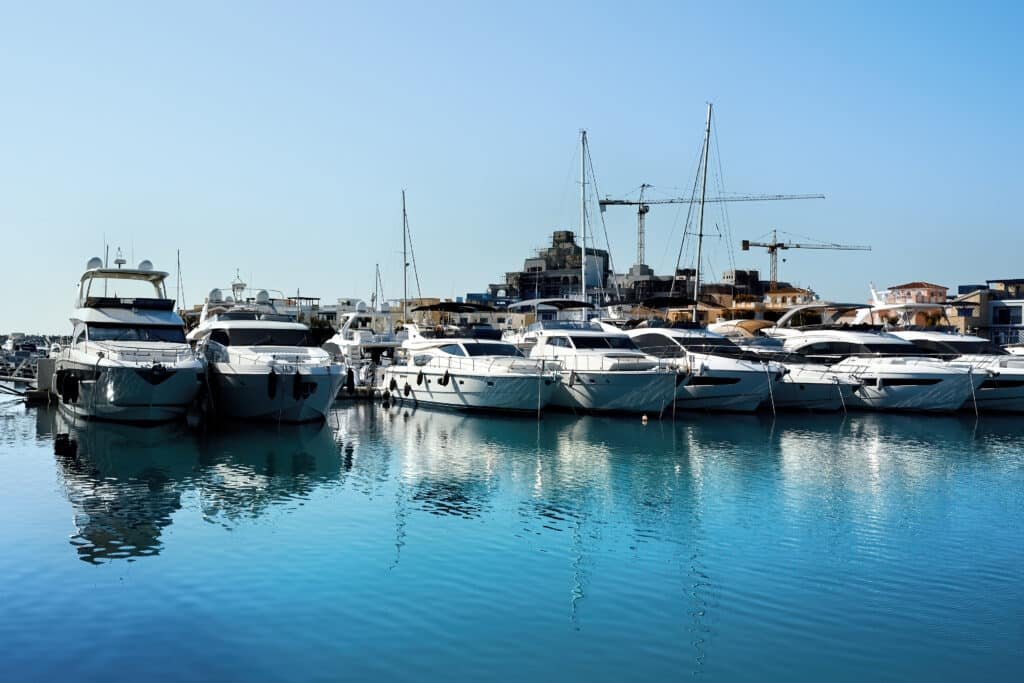
Buying a boat is the dream of many people who live on the coast or visit it often, but the purchase price is only the beginning. Mooring, insurance, fuel, annual servicing… the maintenance costs add up every month, and many owners are surprised to see the bill for the first year. As experts in boat rental in Malaga, And with our own fleet moored at the Benalmádena Marina, we know firsthand what it takes to keep a boat in perfect condition. That’s why we’ve prepared this guide with the actual costs of a small, medium, and large boat, featuring practical examples and tips so that maintenance doesn’t eat into your budget.
A rule that is repeated a lot in the sector, and which in our experience is quite well-implemented, is that maintaining a boat costs around 10% % of its value each year. A boat worth €30,000 can cost around €3,000 per year, although as you’ll see, the figure changes a lot depending on size, port, and how you use it.
The fixed costs of owning a boat
The mooring: the most important expense
The mooring is usually the largest fixed cost, and its price depends primarily on two things: the size of the boat (calculated by length and beam) and the port you choose. On the Costa del Sol, the difference between ports is enormous. The more exclusive ports, such as Puerto Banús in Marbella or the marina of Puerto de Málaga next to Muelle Uno, are designed primarily for yachts and have very high prices, in addition to being very difficult to find for smaller boats. At the other end are cheaper ports, such as Caleta de Vélez in the eastern part of the province, or Estepona, where prices are usually much more affordable. Benalmádena and Fuengirola are in a middle ground, with good services and a very convenient location right in the center of the Costa del Sol.
To give you an idea, a small boat of 5 or 6 meters can cost between 1,500 and 3,000 € per year in a medium-sized port on the Costa del Sol, while in a luxury port that same figure can multiply. A medium-sized boat of 10 meters can easily cost between 5,000 and 10,000 € per year, and a large boat of more than 15 meters easily exceeds 15,000 or 20,000 €. In addition, in high season demand skyrockets and in some ports there are waiting lists, so it’s worth looking ahead.
A very interesting alternative for small boats is the dry marina or storing the boat in a trailer. Instead of paying for a mooring in the water all year round, the boat is stored on land and launched only when you go sailing. It is much cheaper and, in addition, the hull suffers less damage, so you also save on maintenance.
The insurance
In Spain, civil liability insurance is mandatory for any recreational boat, although most owners also contract coverages for damage, theft, or assistance at sea. On a small boat, basic insurance can cost between €150 and €400 per year, while a comprehensive policy for a medium-sized boat can cost around €500 to €1,500. On larger boats, the insurance is usually calculated as a percentage of the boat’s value, so it can easily exceed €3,000 per year. A practical tip: Some ports require minimum coverage to allow you to moor, so check before you sign up for the cheapest policy.
Inspections and documentation
Recreational boats must undergo regular technical inspections known as ITB to check that the hull, engine and safety equipment are in order. On small boats the cost is usually a few hundred euros, but to that must be added the revision or replacement of safety equipment that expires, such as flares, extinguishers or lifeboats on large boats. There are also port fees and some administrative costs for documentation, which although small add up over time.
Variable expenses: what it costs to sail
Fuel
Fuel is the item that varies the most, because it depends directly on how much you sail and at what speed. A small boat with a 100 or 115 HP outboard motor can consume between 20 and 30 liters per hour when sailing at a good speed, which means that a three-hour trip can easily cost between €100 and €150 in gasoline. In a medium-sized boat with an inboard diesel engine, a day of sailing can easily exceed €300, and in a large boat with two engines the consumption can exceed 100 liters per hour. It should be taken into account that the fuel in the port supply is usually somewhat more expensive than in a roadside gas station.
Anti-rust and antifouling
At least once a year, the ship must be taken out of the water to clean the hull and apply anti-fouling paint, known as antifouling, which prevents algae and mollusks from adhering to the hull and increasing fuel consumption. This process includes the crane or travelift, the days spent in the slipway, pressure cleaning and painting. On a small ship the cost is between 300 and 800 €, on a medium-sized one between 1,000 and 3,000 €, and on a large ship it can easily exceed 5,000 €.
Engine maintenance
The engine is the heart of the boat and needs an annual inspection with oil change, filters, anodes, water pump impeller and spark plugs. On a small tender this inspection usually costs between 200 and 500 €. On mid-sized inboard engines the figure rises to between 800 and 2,000 €, and on large boats with two engines and a generator it can exceed 3,000 € per year. Skipping these inspections is the quickest way to end up with a costly breakdown in the middle of the season.
Other expenses that are not usually taken into account
In addition to the main expenses, there are many small costs that appear throughout the year: the water and electricity for mooring, cleaning the boat, batteries, tarpaulins and covers that deteriorate with the sun, navigation electronics, ropes and fenders, or the repair of the upholstery. On large boats, the salary of a skipper must also be added, and in many cases that of a sailor who is responsible for daily maintenance. And we must not forget depreciation: a boat loses value every year, especially in its early years of life.
Practical examples: how much a small, medium and large boat costs per year
For your better understanding, we have calculated three indicative examples based on normal usage on the Costa del Sol.
Small boat (5-7 meters)
It is the most common option for those starting out in boating: a motorboat with a stern drive, ideal for going out with the family, anchoring in a cove or fishing. With a berth in a medium-sized port, basic insurance, an annual engine inspection, a one-year layover, and about 15-20 outings per season, the annual expense usually ranges between 3,000 and 6,000 €. If instead of a berth you use a dry marina or a trailer, you can significantly reduce this figure.
Medium-sized boat (8-12 meters)
Here we are talking about boats with cabins, inboard engines and space for sleeping on board. The mooring, insurance and maintenance of the engine are quite expensive, as is the fuel consumption. A boat of this size can cost between 10,000 and 20,000 € per year, depending on the port and how much you sail.
Large boat (more than 15 meters)
On large boats, like the ones we use on Emotions By Lu for our excursions, maintenance is a constant task. When moored, the insurance and fuel are added to the crew, the two engines, the generator, the electrical systems and all the onboard equipment. The annual expense easily exceeds 30,000 or 50,000 €, and on luxury boats it can be much higher.
| Type of boat | Tie for the year | Insurance for a year | Maintenance and docking | Approximate total |
| Small (5-7 m) | 1.500 – 3.000 € | 150 – 400 € | 500 – 1.300 € | 3.000 – 6.000 € |
| Medium (8-12 m) | 5.000 – 10.000 € | 500 – 1.500 € | 2.000 – 5.000 € | 10.000 – 20.000 € |
| Grande (+15 m) | 15,000 € or more | 3,000 € or more | 8,000 € or more | 30,000 € or more |
Indicative figures. The actual prices depend on the port, the state of the ship and its use.
Consejos para reducir los gastos de tu barco
Si estás pensando en comprar un barco pequeño, hay muchas formas de reducir el coste de mantenerlo. La primera, y la que más dinero ahorra, es elegir bien el puerto: comparar precios entre varios puertos de la zona puede suponer una diferencia de cientos o incluso miles de euros al año, y en muchos casos un puerto algo más alejado ofrece las mismas condiciones por mucho menos. Si tu barco es pequeño, valora la marina seca o el remolque, que te permiten ahorrar el amarre en el agua y reducir la limpieza del casco.
También es muy recomendable hacer un mantenimiento preventivo: revisar el motor antes de la temporada, enjuagarlo con agua dulce después de cada salida y vigilar el estado de los ánodos evita averías mucho más caras. Aprender a hacer tú mismo las tareas sencillas, como la limpieza, el cambio de aceite o la revisión de los cabos, también reduce mucho la factura del taller.
A la hora de navegar, mantener una velocidad de crucero moderada en lugar de ir siempre a máxima potencia puede reducir el consumo de combustible de forma considerable. Y no olvides comparar seguros cada año, porque las diferencias entre aseguradoras pueden ser importantes.
Otra opción cada vez más popular es la copropiedad: compartir el barco con familiares o amigos permite dividir todos los gastos fijos, aunque es importante dejar por escrito cómo se reparten el uso y los costes.
¿Comprar o alquilar un barco?
Antes de dar el paso, merece la pena hacer cuentas. Si solo vas a navegar unos pocos días al año, en vacaciones o en verano, alquilar suele salir mucho más rentable que comprar, porque te olvidas del amarre, el seguro, las revisiones y la varada. Tú solo eliges el día y disfrutas del mar.
Esa es precisamente la filosofía de Emotions By Lu: disfrutar del Mediterráneo sin preocuparte de nada. Con nuestro boat trip in Benalmádena puedes vivir una experiencia completa, compartida o en privado, con tobogán XXL, snorkel, kayak, paddle surf, música y buen ambiente, además de la oportunidad de See dolphins in Benalmádena en su hábitat natural.
Conclusion
Mantener un barco cuesta más de lo que muchos imaginan, pero con una buena planificación se puede controlar el gasto. Un barco pequeño puede mantenerse por unos pocos miles de euros al año si eliges bien el puerto, cuidas el motor y navegas con cabeza, mientras que los barcos medianos y grandes requieren un presupuesto mucho mayor. Y si todavía no tienes claro si te compensa comprar, la mejor forma de descubrirlo es empezar disfrutando del mar con una salida en barco.